IKEA visits continuous cover forestry experiment sites
Researchers presented IKEA with examples of different forest management practices and their impact on climate and biodiversity.
A great way to learn about climate- and biodiversity - smart forestry is to visit forests where a lot of research has been done on the effects of forest management on forest carbon cycle, greenhouse gas (GHG) emissions and biodiversity.
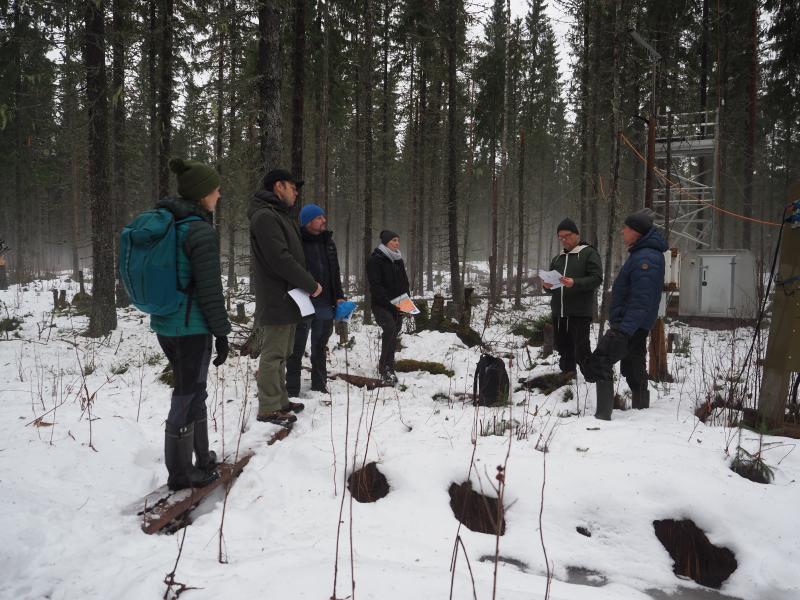
Aleksi Lehtonen, Sakari Sarkkola, Susanne Suvanto, Emmi Hilasvuori, researchers from the Natural Resources Institute Finland (Luke), and Jukka Vornanen, Erika Alm, Mikhail Tarasov from IKEA visited two such continuous-cover forests in southern Finland.
The purpose of the visit was to introduce examples of continuous cover forestry (CCF) in Finland. The first site, Ränskälänkorpi in Asikkala, is an experimental area of fertile Norway spruce forests on drained peatland and the second site located in Evo, Hämeenlinna, is an uneven-aged Scots pine forest on upland soils.
Fertile drained peatlands most promising for continuous cover forestry
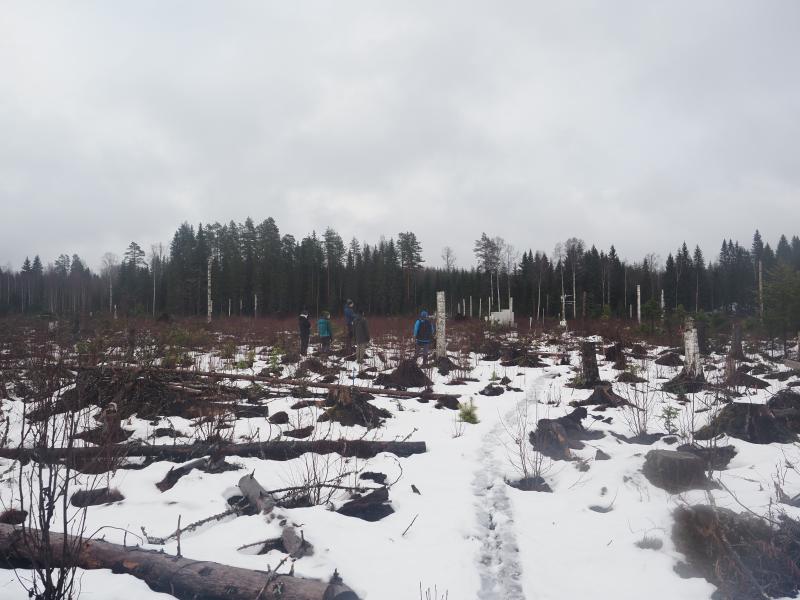
Forestry and GHG emissions in drained peatland forests, and especially the potential of CCF to reduce climate impacts from fertile, nutrient-rich peatlands with high wood productivity, were discussed in Ränskälänkorpi, where experimental harvesting and GHG emissions have been continuously monitored since year 2019.
Monitoring indicates that CCF is more climate-friendly than clear-cutting, particularly in fertile peatlands. For example, CCF helps to maintain more carbon sinks in trees and ground vegetation, thereby mitigating the significant post-harvest net emissions observed with clear-cutting. CCF has also been found to be economically feasible alternative on drained peatlands. The regeneration potential on fertile spruce peatland sites is often sufficient to maintain the uneven-aged structure needed for productive continuous cover forestry.
The experimental harvesting treatments at Ränskälänkorpi include clear-cutting, selection cutting (continuous cover forestry), and a control without harvesting treatments. Intensive measurements are taken to understand the climate- and other environmental impacts of each harvesting treatment.
Continuous cover forestry in Scots pine forests
Discussions in Evo focused on continuous cover forestry in Scots pine forests, its pros and cons including regeneration and production of high wood quality. It was also discussed that continuous cover forestry in Scots pine stands is believed to be challenging due to regeneration problems and this experiment provides a different perspective.
Ränskälänkorpi experimental site is a part of Holistic management practices, modelling and monitoring for European forest soils (HoliSoils), which is EU funded H2020 project coordinated by the Natural Resources Institute Finland (Luke).
HoliSoils aims to develop a harmonised soil monitoring framework. It identifies and tests soil management practices aiming to mitigate climate change and sustain provision of various ecosystem services essential for human livelihoods and wellbeing.