New Horizon Europe project launches to co-create pathways to regenerative livelihoods in the Arctic
A new project, ArcticKnows, has launched under Horizon Europe, bringing together Arctic coastal and local communities to co-design the development of regenerative, just, and climate-wise livelihoods across the region.
Coordinated by the Natural Resources Institute Finland (Luke) and supported by eight Nordic partners, ArcticKnows promotes development of regenerative, place-based economies rooted in knowledge sovereignty, free, prior and informed consent, and meaningful participation—especially of women, youth, and marginalized groups.
“Our work is shaped by community priorities and co-designed with them—not for them. Trust, respect, and knowledge sovereignty are at its core,” says Sabaheta Ramcilovik-Suominen, ArcticKnows coordinator and incoming Research Professor at Luke (from 1 January 2026).
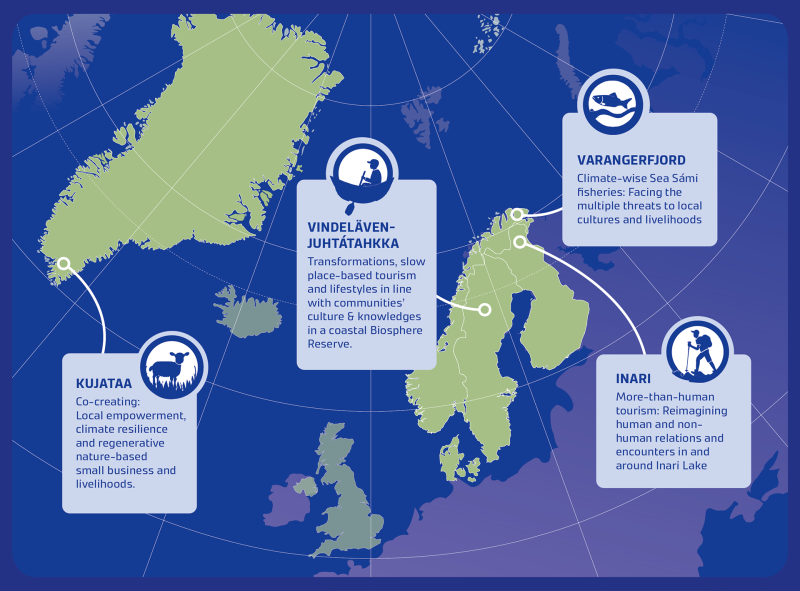
ArcticKnows operates in four pilot regions: Kujataa (Greenland), Varangerfjord (Norway), Vindelälven–Juhttátahkka (Sweden), and Inari (Finland). The focus is on developing community-led models for close-to-nature tourism, climate-resilient agriculture, sustainable fisheries, and other seasonal livelihoods that are ecologically sound and locally meaningful.
The project foregrounds Indigenous and local knowledge systems, working alongside scientific expertise to design place-based economies that are resilient, inclusive, and respectful of both human and more-than-human relations.
At its heart, ArcticKnows embraces multispecies coexistence and justice. It will develop practical tools — such as maps, methods and guidelines for onto-epistemic justice and co-creation — to embed regenerative economies and multispecies justice into planning and decision-making. Animals, plants, rivers, glaciers, and ecosystems are seen for what they are - living relations and active participants in shaping present and futures.