
A joint Nordic book on continuous cover forestry
The book Continuous Cover Forestry in Boreal Nordic Countries, produced through collaboration among Nordic research institutes, addressed the need for information on the opportunities, bottlenecks, and practical application of continuous cover forestry in boreal forests. One year after its publication, in December 2025, the book had been downloaded an impressive 70,000 times.
Even-aged forest management has long been the dominant method in Finland, Sweden, and Norway. In recent years, interest in Continuous Cover Forestry (CCF) has grown across the Nordic countries. CCF is more common elsewhere in Europe, and the European Commission has proposed adopting it as the main forest management method. This development reflects a shift from timber production toward more multifunctional forest use.
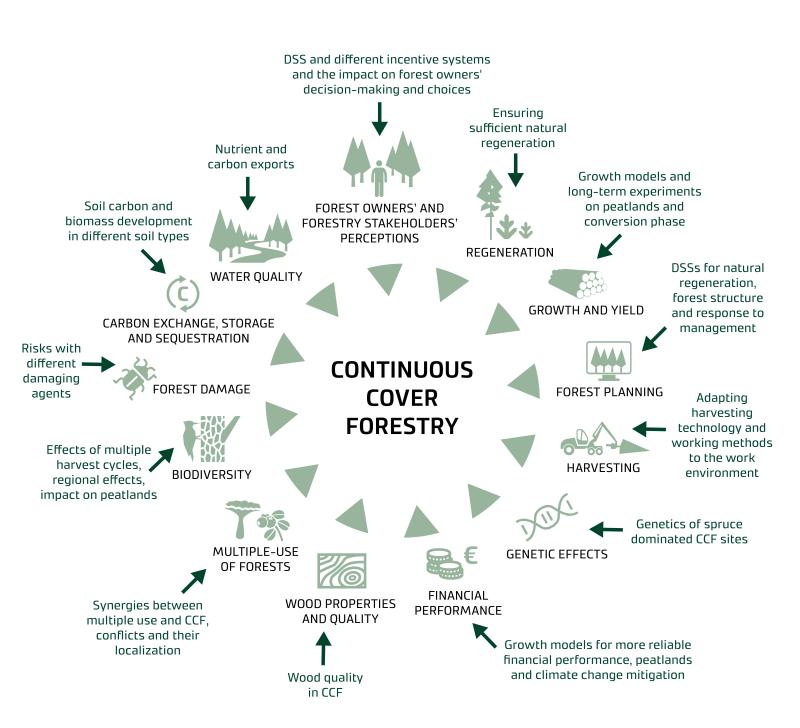
Luke brought together a Nordic research network with the goal of synthesizing what is known about continuous cover forestry—resulting in the English-language book Continuous Cover Forestry in Boreal Nordic Countries. The book compiles current knowledge and identifies key knowledge gaps. In addition, a policy brief was produced to support sustainable and multifunctional forest management.
The book, created through Nordic collaboration, provides a foundation for developing and applying CCF in boreal forests. Published in December 2024, it is freely available for download from the publisher’s website, where by December 2025 it had already been downloaded 70,000 times.
Solutions for Multiple Objectives — But Also Limitations
Nordic forests and the forest-based bioeconomy are central sources of well-being. Forests provide diverse ecosystem services, including raw materials, carbon sequestration, biodiversity, and recreational opportunities. Environmental and societal changes — such as climate change and the diversification of forest owners’ values — challenge traditional forest management practices and call for new approaches.
CCF has been suggested as a way to combine multiple objectives, such as landscape values, carbon sequestration, biodiversity, and economic profitability. At the same time, it is important to recognize the limitations and uncertainties of the method. For example, its effects on forest growth, regeneration, pest risks, and economic returns remain partly unclear, especially under boreal conditions.
Since practical forestry and research have largely focused on even-aged management, only limited and fragmented research data on CCF is available. Forest owners need well-founded and site-specific advice on where CCF is suitable and where traditional rotation forestry remains the better option.
Unite Flagship awarded the book with an Impact Award.
”It is important to understand the opportunities and challenges of Continuous Cover Forestry. There is an urgent need for knowledge about the impacts of different methods and answers to existing knowledge gaps, so that forest owners and stakeholders can be provided with guidance on where and when to apply continuous cover or rotation forestry”, justifies Juha Hakkarainen from Finsilva.
There is an urgent need for knowledge about the impacts of different methods and answers to existing knowledge gaps, so that forest owners and stakeholders can be provided with guidance on where and when to apply continuous cover or rotation forestry.”
Nordic forests are expected to provide multiple ecosystem services simultaneously: such as raw material production, carbon sequestration, biodiversity conservation, and climate change adaptation. These objectives may conflict with each other and reconciling them requires diverse forest management methods. CCF is not a solution to all challenges, but it can complement even-aged management, particularly in areas where forestry has multiple objectives.
The suitability of methods depends on forest characteristics, such as tree species, site conditions, and management history. For example, shade-tolerant spruce requires different approaches than light-demanding pine. Safeguarding biodiversity requires maintaining structures such as large living and dead trees, regardless of the method used.
Further research on the impacts of CCF is needed. Long-term monitoring and studies are essential to understand the ecological, social, and economic effects of the CCF method.


More information


Further reading
More on research impact
Kirjaa on tehty osin Suomen Akatemian lippulaivan UNITE:n rahoituksella. UNITEssa tutkitaan ja kehitetään metsien, ihmisten ja koneiden vuorovaikutusta. UNITE-osaamiskeskittymään kuuluu tutkimusryhmiä Itä-Suomen yliopistosta, Maanmittauslaitoksen Paikkatietokeskuksesta, Tampereen yliopistosta ja Luonnonvarakeskuksesta (Luke) sekä laaja kehittäjäkumppanien verkosto.